Evaluating Balrose: A Practical Guide to Using This Distinctive Display Type
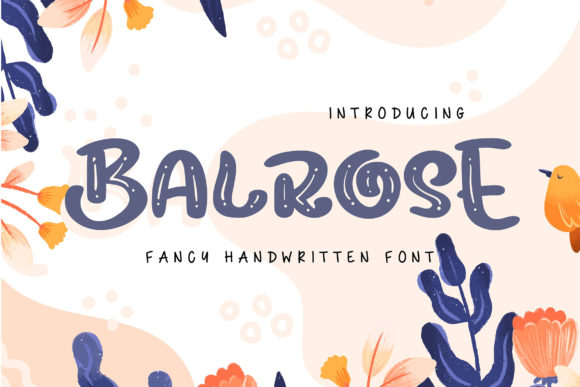
Selecting the right typography is rarely a simple matter of picking the "prettiest" letters on a screen. It is an exercise in communication, brand alignment, and technical feasibility. For designers working on projects that require a specific blend of whimsy, clarity, and structural integrity, Balrose has emerged as a notable option. Characterized by its cute, round letterforms and playful display aesthetic, this font offers a distinct visual voice that stands apart from standard sans-serifs or traditional serifs. However, understanding its full potential requires looking beyond its surface charm to examine its encoding structure, versatility, and ideal use cases.
This evaluation aims to help creative professionals, marketing specialists, and hobbyists determine whether Balrose fits their workflow. By analyzing its design philosophy, technical specifications, and practical applications, we can identify where it excels and where alternative typefaces might serve a project better.
Understanding the Design Philosophy of Balrose
At first glance, Balrose presents itself as a fun, approachable display font. The term "cute" in typography often refers to rounded terminals, soft curves, and a lack of sharp, aggressive angles. Balrose embraces this quality fully. Its letterforms are constructed with a consistent thickness and a friendly demeanor that immediately lowers the cognitive load for the viewer. Unlike grotesque sans-serifs that strive for neutrality, Balrose makes no attempt to hide its personality.
The font’s distinctiveness lies in its balance between readability and decoration. Many decorative fonts sacrifice legibility at smaller sizes to achieve a unique look. Balrose, however, maintains a clear x-height and open counters (the negative space inside letters like 'o' or 'e'). This ensures that even though the font is stylized, it remains accessible. It is designed to be seen, not just read, making it particularly effective for headlines, logos, and packaging where immediate visual impact is required.
Furthermore, the "roundness" of Balrose contributes to a sense of modernity. In a design landscape often dominated by geometric minimalism, Balrose offers a softer alternative that feels organic yet controlled. This makes it suitable for brands in sectors such as children’s products, lifestyle blogs, artisanal foods, and creative agencies looking to convey warmth and approachability.
Technical Considerations: The Advantage of PUA Encoding
One of the most critical aspects of using any font in a professional workflow is how glyphs are accessed and managed. Balrose utilizes PUA (Private Use Area) encoding. To understand why this matters, it is helpful to look at how fonts are structured. Standard Unicode encoding assigns specific code points to characters based on international standards. While this ensures consistency across platforms, it limits the number of available symbols and stylistic variants within a single font file.
PUA encoding bypasses these limitations by placing additional glyphs—such as swashes, ligatures, alternate characters, and decorative elements—in the unused Private Use Area of the character map. For users of Balrose, this translates directly into ease of access. You do not need to hunt through multiple font files or rely on complex OpenType feature toggles to find the special characters that give the font its flair. All glyphs and swashes are accessible with ease through your operating system’s character viewer or design software’s glyph panel.
This technical choice has significant implications for efficiency. When creating a logo or a poster, a designer often needs to experiment with different variations of a single letter to find the perfect composition. With Balrose, swapping a standard 'a' for a swashier version is a matter of a few clicks. This streamlines the creative process, allowing for rapid prototyping and iteration. It reduces the friction between idea and execution, which is a valuable asset in fast-paced design environments.
Accessibility and Workflow Integration
While PUA encoding is powerful, it does require a certain level of digital literacy. Users must be comfortable navigating character maps and understanding that these glyphs may not appear correctly if copied and pasted into plain text fields that do not support rich formatting. However, for primary design work in tools like Adobe Illustrator, Photoshop, or Canva, this is rarely a hurdle. The ability to add these elements confidently to your favorite creations without worrying about compatibility issues within the design environment is a major benefit.
It is also worth noting that because PUA glyphs are not part of the standard Unicode set, they will not function in search engines or basic text searches. Therefore, Balrose should be used for display purposes where the text is rendered as a graphic element, rather than for body copy that needs to be selectable and searchable. This limitation reinforces its identity as a display font rather than a reading font.
Comparing Balrose to Alternative Approaches
When evaluating Balrose, it is useful to compare it against other common typographic strategies. Designers often face a choice between custom illustration, standard decorative fonts, and variable fonts. How does Balrose fit into this spectrum?
- Custom Illustration vs. Font Usage: Creating a custom wordmark from scratch offers unlimited uniqueness but requires significant time and expense. Balrose provides a middle ground. It offers a high degree of customization through its swashes and alternates without the cost of bespoke design. If you need a unique look but have budget or time constraints, Balrose is a strong candidate.
- Standard Decorative Fonts: Many "cute" fonts suffer from inconsistent stroke weights or awkward kerning. Balrose distinguishes itself through its polished execution. The roundness is uniform, and the spacing is generally well-calibrated for display sizes. Compared to lower-quality novelty fonts, Balrose feels more professional and less like a clip-art element.
- Minimalist Sans-Serifs: If the goal is pure neutrality, Balrose is the wrong choice. It draws attention to itself. In contexts where the message must remain invisible, such as legal documents or data-heavy dashboards, a neutral sans-serif is superior. Balrose shines when the design itself is part of the message.
The decision ultimately hinges on the desired emotional resonance. Balrose evokes playfulness, creativity, and friendliness. If your project requires authority, seriousness, or urgency, other options will likely serve you better. However, for projects aiming to connect on a human, informal level, Balrose aligns closely with those goals.
Best-Fit Situations and Limitations
To make an informed decision, it is important to recognize where Balrose thrives and where it may struggle. Its strengths are most apparent in short-form communications.
Ideal Use Cases
Brand Identity and Logos: The distinctive shapes and available swashes make Balrose excellent for logo construction. The round forms can be manipulated to create memorable icons or monograms.
Packaging Design: For consumer goods targeting families, kids, or creative consumers, Balrose adds shelf appeal. Its visibility at small distances helps products stand out in crowded retail environments.
Social Media Graphics: In the fast-scrolling world of social media, bold, cute typography grabs attention. Balrose’s high contrast and clear shapes render well on mobile screens, ensuring readability even at thumbnail sizes.
Event Materials: Invitations, posters, and banners for parties, workshops, or community events benefit from the font’s inviting tone. It suggests celebration and engagement.
Limitations and Tradeoffs
The primary limitation of Balrose is its lack of versatility in long-form text. Using it for paragraphs of body copy would create visual fatigue. The eye would struggle to track the lines due to the heavy styling and rounded forms. Additionally, while the PUA encoding is convenient, it means the font is not self-contained in terms of standard web font embedding for dynamic text. If you plan to use Balrose on a website, you typically need to convert text to outlines or images, which can impact SEO and accessibility if not done carefully.
Another consideration is market saturation. Because "cute" and "rounded" fonts are popular trends, there is a risk of your design feeling generic if you do not pair Balrose thoughtfully with complementary elements. The key is to let the font speak for itself without overcrowding the layout. Negative space becomes crucial when using a font with such strong character.
Making the Final Decision
Evaluating Balrose comes down to matching its specific attributes to your project’s needs. If you are looking for a tool that combines ease of use with a strong, friendly aesthetic, Balrose is a compelling choice. The PUA encoding removes technical barriers, allowing you to explore creative possibilities without frustration. Its round, cute lettering offers a refreshing alternative to the coldness of many modern design trends.
However, it is not a universal solution. It should be viewed as a specialized instrument in your design toolkit. Use it when you want to inject personality, warmth, and playfulness into your work. Avoid it when you need subtlety, speed-reading efficiency, or strict formality. By understanding these boundaries, you can leverage Balrose to create outcomes that are not only visually stunning but also strategically appropriate. Let yourself be amazed by the outcome generated when you apply this font with intention and care.